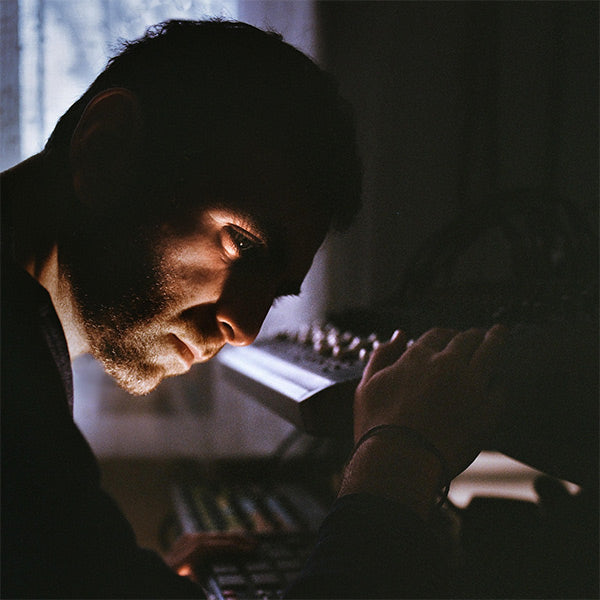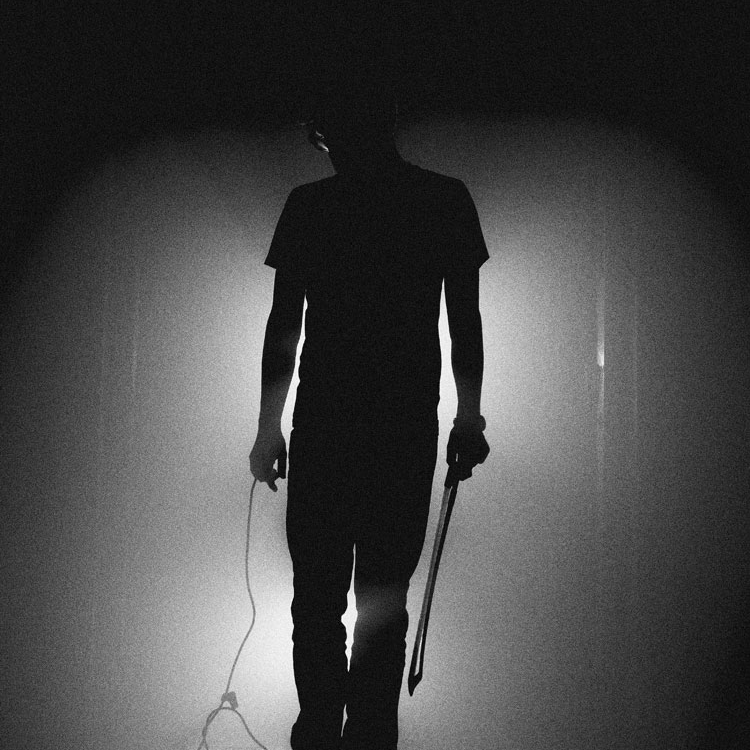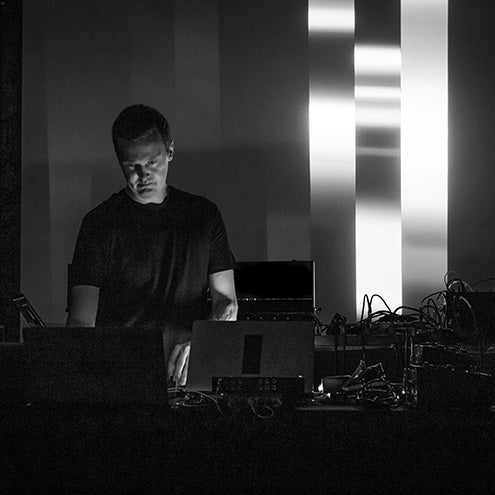
RlainhartRichard Lainhart is an award-winning composer, author, and filmmaker - a digital artisan who works with sonic and visual data. Since childhood, he's been interested in natural processes such as waves, flames and clouds, in harmonics and harmony, and in creative interactions with machines, using them as compositional methods to present sounds and images that are as beautiful as he can make them.

Puremagnetik sound designer Brian Cass talks with Richard about his unique studio setup, favorite sound making devices and more.


Your music career has traveled an interesting trajectory from vibraphonist to synthesist. Can you walk us through your evolution as a musician and composer?


I started out, like many musicians, falling in love with the current pop music of my teenage years and wanting to play it myself. In my case, that led me to the electric bass, my first instrument. But I also had an interest in recording and audio electronics through my father, who was an audiophile and who owned a hi-fi store. From him I got my first tape recorder, a quite decent (for the time) pro-grade Ampex, at around the same time I started playing bass. Soon I started listening to more adventurous music, like Zappa and the proggers, and started experimenting with my bass and tape deck, making weird sounds. That led me to electronic and avant-garde music, which led me to the university where I got my first hands-on experience with the big Moog modular systems of the time, and where I spent many happy hours in the studio, making tape music. That was at the State University of New York at Albany, the home of the mighty CEMS System, one of the largest Moog modular systems ever built, and where I studied with Joel Chadabe, one of the pioneers of electronic music. That's also where I had my first contact with some of the great composers and performers of electronic music, many of whom came through the studio to work on their own music; as studio assistant, it was my job to help them with their work and at times to perform with them.

After school, I worked as a live sound engineer for a while, and hooked up with a band that played early jazz and Swing. I'd played a little bit of vibraphone in school when I studied percussion there, but not in any serious way, until the guys in the band asked me to play with them when I wasn't doing sound. I became completely infatuated with the jazz of the 20s, 30s, and 40s, and focused exclusively on that for some years - from being a hardcore electronic composer and avant-gardist, I turned completely around and listened only to music from that time. I didn't even have a stereo turntable, because I only listened to mono records. During that period, I worked as a professional performing musician, learning and playing only acoustic jazz.

Eventually, though, I tired of the pro music life, and got out of it to start working as a computer tech with the early Macintoshes, focusing on music production, as the Macs were about the only platform then you could do music with. That, inevitably, brought me back to electronic music, but this time in the environment of digital audio and MIDI rather than analog synths and tape decks. Eventually, I worked as Technical Director for Intelligent Music, one of the very first developers of music software for the Macintosh, and later for the Atari and Amiga platforms. I did tech support for Intelligent Music, as well as writing manuals, all of which was good training for what I do now. It also brought me into contact again with many more interesting musicians and producers of electronic music of all sorts.

From there I moved to New York City and worked with one of the early developers and integrators of digital video editing systems for the Macintosh, which brought me into contact with a whole other group of interesting digital filmmakers and animators, and which led me to my own interest in computer-animated film. And all the while, I continued to write and perform music, although this time much more on my own terms.

So, my evolution was a little unusual, perhaps, but I learned a lot about many different kinds of music and music-making, so I think it was all worth it.


In your current setup you are using a specific patch configuration on the Buchla along with the Haken Continuum controller. For our B-System Basses and Leads MicroPak, I created some patches that were recorded from and programmed to emulate this configuration. Can you tell us a little about the patch and how you are using the Continuum with it?


The reason I got the Buchla in the first place was to have a flexible modular system that I could perform with, which the Buchla is ideal for because of its patch memory. So, since I've gotten it, I've been developing and adding to one master performance patch, which lets me change its configuration quickly in performance but still allows for the maximum degree of sonic variety. That's the patch you're referring to, and which by now, after a couple of years of work, has gotten pretty dense and complex. The Continuum interfaces with that patch via the Continuum Voltage Convertor, or CVC. The Continuum senses finger position on its surface in three dimensions - horizontal, vertical, and depth or pressure - and the CVC converts the data stream from the Continuum into a set of 12 separate control voltages of three dimensions of control for up to four separate voices. Most of the patches are set up so that the X dimension controls pitch, Y controls filtering, and Z controls amplitude, but there are some patches where the Y dimension controls oscillator waveshaping or timbre modulation,for example, or the Z dimension control modulation index. It all depends on the patch and what I want to be able to control in that particular sound, and the system has a lot of flexibility that way.


I really enjoy your interpretation of Olivier Messiaen's composition Oraison. Can you tell us about the composition and how you came to realize it for new technology 70 years later?


Thank you! Oraison was originally written by Messiaen in 1937 for six Ondes Martenot, one of the first purely electronic instruments, and was part of a suite of pieces intended to be played live at the Paris Exposition in that year. It's a beautiful piece in its own right, and has historical interest too, because it may have been the first piece of music written expressly for live, completely electronic, music performance. It was also adapted by Messiaen as one movement of his "Quartet for the End of Time", which he composed in a German prison camp while a prisoner of war there in WWII. The Quartet is one of the great classics of 20th-century music, especially given the circumstances under which it was written.

The Ondes Martenot is a very expressive electronic instrument - Maurice Martenot, who invented it, was a cellist, and wanted an electronic instrument that could be played with the same degree of expression as a string instrument. Oraison is a piece I've always loved - I first heard it years ago as a student - and when I got the Buchla/Continuum system, I realized that the Continuum would let me play the piece myself, as it's a superbly expressive controller, with the advantage that it's polyphonic, unlike the original Ondes. So I spent some time transcribing the piece from the original score, then spent a lot more time practicing it. The Buchla let me program a sound that was similar to the Ondes, but with even more expression in the timbre control, and that's what I used for my version. So, my own realization is a kind of analog-digital homage to the original - analog in the sound-producing domain, but digital in the control domain.


We've now done two sampling sessions with you and your Buchla system. Now that we have B-System Percussives and B-System Basses & Leads, what do you think the third and possibly final installation of the B-System series should be called? B-System Textures? B-System Pads?


Pads would certainly be fun - I have quite a few sounds that would work for that - but Textures has a lot of appeal too. I'm attracted to both the tonal sounds the system can make as well as the non-tonal or more atmospheric, and they both have merit. How about some of each?


Besides the Buchla and Continuum, what other pieces of Hardware or Software do you employ when composing or performing?


I love playing the electric guitar, and fortunately I was able some years ago to pick up a wonderful white Steinberger GL7TA which is one of my all-time favorite instruments. Based on that instrument, and parallel to my work with synthesizers, I've developed a body of works for processed guitar that I've been working on for 10 years or more now. For those pieces, I use a variety of processing apps and plugins running on the MacBook Pro, including Max/MSP, Reaktor, and Logic, and plugins like Pluggo, SpectralMagic, SoundToys, GRM Tools, OhmBoyz, and a bunch from the WaveArts and Smartelectronix developers. But probably my favorite guitar processor is the Kyma system, a very deep and powerful DSP programming environment that I've done some good work with but have really only scratched the surface of.


Is there any Hardware or Software that you don't currently use but that you hope to add to your collection?


If you're an electronic musician, there's always something you want but don't have, right? And if there isn't, there will be soon. For me, it's the new Kyma Pacarana, a smaller but more powerful version of the Kyma Capybara I currently own. And I wouldn't mind having an Eventide h8000fw….


You have performed along with some of the major composers in the modern era of minimal and experimental music. Is there any particular performance or composition that stands out as a life-changing experience for you?


There were several, but one of the most extraordinary was the New York premiere of John Cage's HPSCHD at the Brooklyn Academy of Music in 1975. There were six harpsichordists, 12 tape decks running tapes of electronic music and found sounds, 16 film projectors showing NASA footage, and over 100 slide projectors projecting slides of all kinds of solar, lunar, and space imagery. I was the boss of the tape crew, swapping out the tapes and making sure all that part of the audio presentation ran smoothly. It ran for over seven hours, as I recall, and it was like being in the middle of a volcanic eruption of light and sound - a truly transcendental experience.


Do you have any new releases or events that you can tell us about?


A few things - a new disc of Buchla music, called "The Line of the Horizon", which I'm probably going to self-release as a limited-edition numbered CD and through the various download services soon. I just recently released my first vinyl recording too, a 10" limited-edition of guitar music that I split with Hakobune, a wonderful Japanese guitarist on his Tobira label. VICMOD, an electronic music label in Australia, is going to be releasing a pair of CDs of a lot of my older electronic tape music from the 70s in the next couple of months. And I'm going to be part of a compilation of new electronic music on the Russian Electro-shock label coming out in the Spring. Beyond that, there are some other possible releases I'm working on, including a disc of new music on the German Ex Ovo label, and perhaps another with them besides.

I have a fair number of performances coming up too, including one I'm very excited about, which is playing and doing a workshop at Netmage 2010, a festival of electronic art and music in Bologna, Italy, at the end of January. It will be my first live European performance, and I'm really looking forward to it, once I figure out how to get the Buchla over there in one piece....


Richard Lainhart
http://www.otownmedia.com
http://www.downloadplatform.com/richard_lainhart
http://www.vimeo.com/rlainhart
http://www.youtube.com/rlainhart
http://richardlainhart.bandcamp.com/

facebook_button_1 twitter-button youtube soundcloud

Clap Box